

Next up for National Train Your Dog Month is barn hunt!
As always, these posts focus on my knowledge and experience of the sport. Consult the various links in the posts for more information.
What is it?
The essence of barn hunt is hide and seek with rats in a maze of hay bales. Fear not; the rats are safely secured inside plastic tubes with holes. Depending on the level your dog is competing in, the number of rats hidden will vary. There will also be at least one tube that is completely empty, while another will have “litter” (or bits of hay/bedding that smells like rats).
The tubes are hidden in a course of bales of hay. Your dog is to sniff out the rats, signal to you that they found a rat, and you proclaim, “Rat!” In addition to successfully identifying all hidden rats, your dog must also climb atop a bale of hay and complete a tunnel.
As far as I know, the only organization that sponsors barn hunt trials is the Barn Hunt Association. Your dogs must be registered with them to compete in trials hosted by various dog clubs. When you earn barn hunt titles, the American Kennel Club (AKC) will recognize the title, for a fee, of course.
How we started
When Cookie started her journey with agility, we became members of a local dog sports club. Barn hunt was another sport that they hosted competitions in. I was a bit averse to the concept of searching for rats, but friends in the group suggested trying it, telling me that no training was needed.
So I did. Cookie and I signed up for an initial trial. She started with the instinct level, the most basic round. There are 3 tubes that are not hidden in hay. They sit in a rack on the other side of the tunnel. Climb and tunnel are optional at this level. The goal is for your pup to identify the tube with the rat, for you to correctly guess based on your dog’s cue, and move on.

Cookie, Ziggy, and Chip all competed in barn hunt, but Cookie is the only one not to title in Instinct. The reason is that titling in instinct isn’t required to compete in the next level up, and once you title in novice, you can’t compete in Instinct.
Once Cookie got started in novice, she quickly moved up to earn her novice title and came one qualifying run short of titling in the open. Cookie got stuck in open when Ziggy came along. When Ziggy started competing, he would bark the entire time that Cookie was competing, and she instantly became more preoccupied with the well-being of her brother than finding rats.
When the pandemic hit and Ziggy’s cancer journey began, all competition stopped. Last August, we signed Chip up for his first barn hunt trial. He’s a pro at finding the rats but is too nervous to tunnel. And Cookie remains uninterested in finding rats.
What they don’t tell you
The club that I started with in barn hunt always said that you didn’t need training in barn hunt and to just rely on your dog’s instincts. This worked for Cookie and Ziggy, but Chip would benefit from training (which I didn’t know was a thing for barn hunt until after his first trial). While the instinct may be there to find the rat, your dog may need training to learn to tunnel or also to exit the ring. Chip was hard to catch once our turn was up. The judge advised that it is something that he could be disqualified for, which would be a shame had he qualified in novice.
Competing in barn hunt is significantly more expensive than agility. It may seem surprising at first, but upon inspection, it makes sense. The equipment in agility can be used for years through countless competitions. But the key “equipment” in barn hunt are live rats. Additionally, while bales of hay can be reused while they remain intact, it’s not uncommon for dogs to mark on them (or paw or bite them). While it’s common to charge the owner a fee when this happens, bales of hay don’t last nearly as long as agility equipment.
How dogs signal that they’ve found a rat can vary wildly. I’ve seen some dogs go CRAZY barking and biting bales of hay to say they found a rat. Meanwhile, others, like Cookie, go completely still. (According to the judge who made this observation, Cookie was “disgusted” by the rats!)
I also learned how your dog signals can change over time. Once Cookie started getting stuck in open, I wish I had taken a break from trials and instead took a couple of classes or done a fun run to learn if she was changing how she was signaling or if she truly lost interest in the sport.
The bottom line
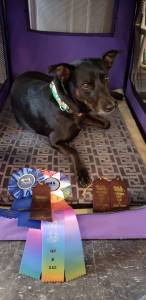
Barn hunt is a less physically demanding sport compared to agility. It leverages your dog’s natural hunting instincts but can benefit from practice and classes.
Like with everything else, explore your dog’s interests and simply HAVE FUN!! Even if your dog doesn’t find a rat in the competition, every judge we’ve competed under has made sure that a rat tube is presented to the dog to sniff and for excitement to be demonstrated so they leave the ring on a pawsitive note.
 pawrentingtails.com