Given the frequency with which I haven’t posted this year, it probably seems odd to write a post announcing that I’m stepping back from the blog.
It probably seems I already did that, but it wasn’t intentional. Nearly every week I have the blog on my to do list. After my previous post, I told myself that I would lower my goal to posting monthly and to try spending 15 minutes each week on a single post. I figured if I could slowly build that habit, I’d get back into it and work up to posting at least twice a month again.
But I realized that my to do lists (yes, there’s more than one), are too long and I put unnecessary pressure on myself to get it all done. And I ultimately end up disappointed when I don’t get to certain things like posting to the blog.
I started this in part as a way to process my grief over losing Ziggy. And also to share what I learned from Ziggy and through his cancer journey. There’s still a lot that I want to share – some lessons not specific to him. But there are other things that I need to focus on and prioritize.
So, I am intentionally stepping away from goals or expectations with this blog. I may write when the mood strikes me, or you may never hear from me again.
I have also learned that blogging and creating social media content is not as simple as it may seem. I have gained more respect for those who pursue that full-time and even those who do it successfully as a hobby or side hustle.
Cheers to a happy holiday season and a new year!
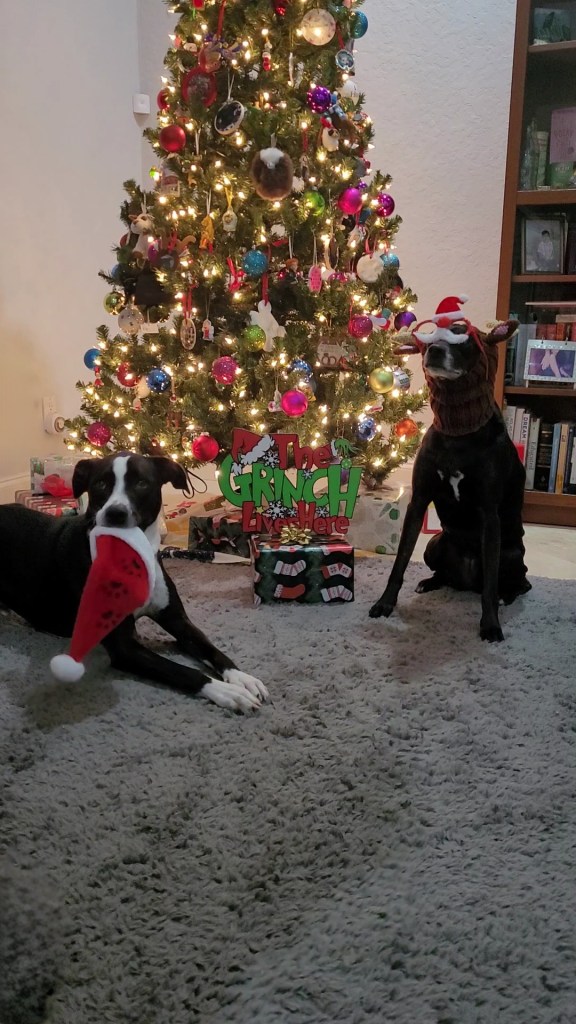
Chip and Cookie posing with a Santa hat, reindeer snood, and Santa glasses. Christmas 2024
Well, I certainly didn’t plan on four months flying by after my last post. Nearly every week, I tell myself to make a post and not overthink it, but invariably, I find an excuse not to.
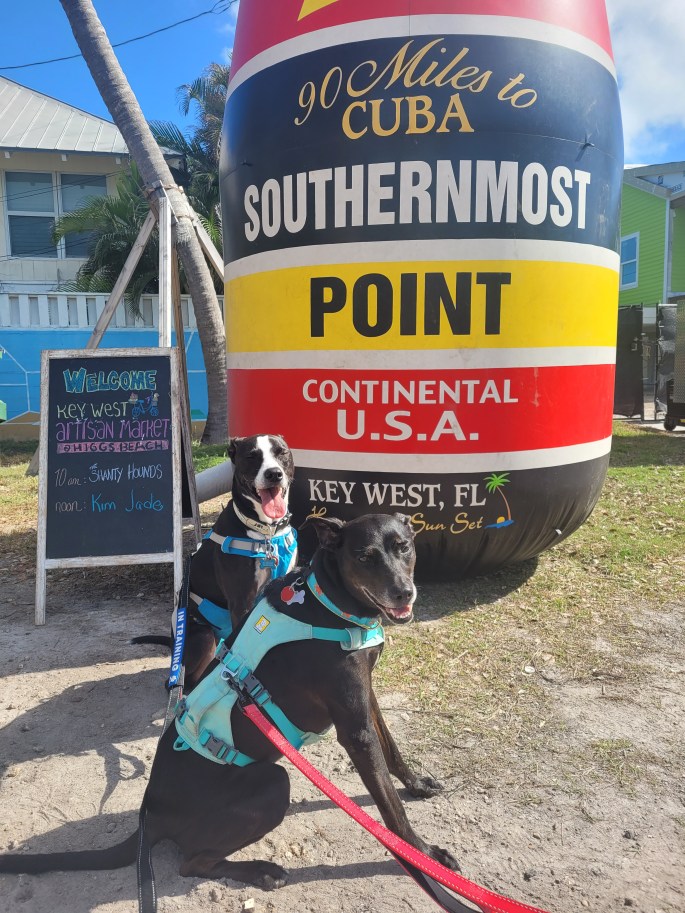
The pups had a busy few months with a trip to Key West, Chip’s first time at dog day at the beach, and a few minor health issues – fear not, everyone is well (and I plan to write about both at some point).
With the start of Ziggy’s cancer journey, coupled with the peak pandemic, since Thanksgiving 2020, the holiday has been one mostly spent with my husband and the pups. I’m grateful for the shrinking of the holiday as it reduces stress and allows for a long weekend to gear up for the end of the year. I’m not fond of the origin of Thanksgiving, but I like to take the opportunity to be more mindful of what I have to be grateful for each. Plus, it’s the “official” start to the Christmas season, which is always cozy.
This year, I’m particularly grateful for health—for the pups and for ours. Inevitably, we all experience varying degrees of illness or health challenges. While the last few years have been marked by canine cancer, I’m grateful that everyone is healthy overall.
It can be hard to express gratitude for what we have each day, but I am always grateful for Cookie and Chip, who always bring joy, comfort, and love, no matter what is happening around us. (And my husband, too, who can always be counted on to make me laugh – intentionally or otherwise! 😜)
Hello! It’s been a while since the last post. I’ve been trying to get back in the habit for at least a month, but life has been “life-ing.”
Shortly after my last post, I got COVID and was out of commission for about a week. Then there was catching up on work and life after being sick, home projects that took time, a road trip (with the pups!), and a bunch of other reasons why the blog went on the back burner.
I have several blog post ideas bouncing around my brain, but I have had some mental blocks to drafting them.
In the meantime, I wanted to post something to let you know that I haven’t given up on the blog.
First Rally Competition
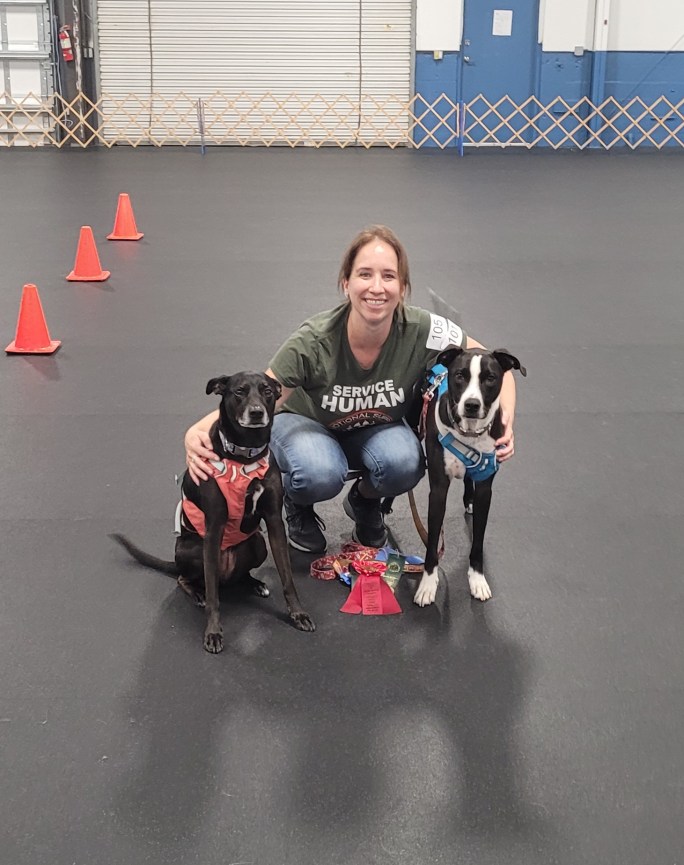
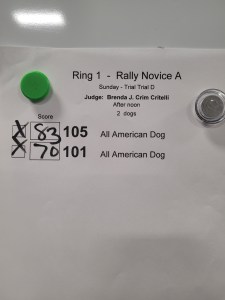
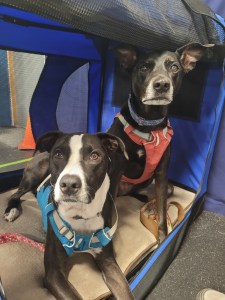
Chip and Cookie participated in their first AKC rally competition this past weekend. We only entered on one day, but they were the only two competing in their class (novice A). They were disqualified during their first run of the day because their lead was too tight. They fared better in the second run – with Chip earning first place and Cookie getting second place (thanks to the judges’ pity points!).
Chip and Cookie’s scores. To qualify, you need a score of 70 or more.
Chip’s Performance
I’m incredibly proud of Chip’s performance in both runs and outside the competition ring. Their crate was positioned near the entry to the competition ring, so dogs were constantly walking past his crate. He ignored or calmly observed them all. While in the ring, he generally listened to me, did what I asked (eventually), and didn’t bark (at the judge or the competitors sitting outside the ring). Last summer, Chip was in a training class for reactive dogs. The progress he’s made is TREMENDOUS. The official qualifying score and first place are the icing on the cake for us!
Chip’s “award-winning” rally run!
Cookie’s Turn
Cookie is an excellently trained, competitive, eager-to-please pup. She has repeatedly “told” us (in class, this trial, and elsewhere) that she’s done. She’s only interested in the “paycheck” (chicken or cheese). At 10, Cookie has earned the right to retire. So we’ll provide her with mental enrichment in other ways – practicing for fun at home, going on special outings, and bringing her along as Chip’s cheerleader.
Regardless of her score, she qualified as a comedienne in my book – sitting backward in the first run and jumping on me during the second. She channeled her inner mischievous puppy.
This is Cookie’s first run that disqualified her. The qualifying run wasn’t recorded, but take my word for it – it wasn’t much better.
Bottom line
Chip and Cookie await the ribbon ceremony so they can go home and have dinner.
I want to take the opportunity to thank the trainers that my husband and I had when we first started our dog sports journey 10 years ago with Cookie. They always emphasized having fun with our dogs, celebrating our runs (no matter how sloppy they may be), and always ending on a positive note. Some people focus too much on competing and earning titles and lose sight of these sports as opportunities for bonding and fun.
If you’re disappointed in your dog, you’re doing it wrong. And always listen to your dog before you listen to anyone else.
He may no longer be with us physically, but today we celebrate Ziggy’s fifth gotcha day.
How it started
Cookie, before knowing she was about to be a big sister, on 3/23/19.
My husband and I first discussed getting a second puppy shortly after moving into our new home. Our main criteria was that Cookie had to approve. We hoped to get a puppy that would ultimately be about her size, not that there was any guarantee.
We attended an adoption event about a month before we ultimately adopted Ziggy. As the event was winding down, we found ourselves filling out paperwork to adopt a puppy. The puppy snapped at Cookie, and we, plus the rescue organization, decided it wasn’t the right fit/time.
For several days afterward, Cookie became super clingy—which is unlike her. While she enjoys our company, she is not affectionate and loves her personal space. We started rethinking a second puppy. Maybe Cookie was destined to be a furever only child.
The big day
On National Puppy Day 2019, we went to an adoption event. I didn’t realize it was purely an adoption event. I thought it was a pet expo with a bunch of dog vendors and some adoptable pups.
My husband and I argue over who saw Ziggy first, but since this is my version of the story, we’ll go with I saw Ziggy first and made a beeline for him. After an initial hello, we did a lap around the event and came back to say an extended hello. Something that stuck out to me is that there was a row of crates behind him and all the pups in that row were barking and being all kinds of rambunctious. Ziggy was quiet. He was facing them and interested in all their yapping, but he didn’t really have anything to say.
3/23/19: Ziggy saying hi before coming out of his crate.
When we opened the crate door, Cookie walked up slowly, sniffed him, and looked at us as if to say, “Ok, I sniffed him. Can we go home yet?” Ziggy was the only adoptable dog that she voluntarily went up to. Even before the previous month’s event, she seemed to know when we were around adoptable dogs and always looked nervous. As though she was worried that she was going to be exchanged.
My husband and I alternated saying hi, and Cookie kept her distance, ready to go home. The lady from the rescue group mentioned he needed a bath because he rolled in his own poop en route to the event. (Which he would eventually roll in some kind of poop at least twice…notably once during my WFH lunch break my first week at my new job at the start of he pandemic!).
There wasn’t even a hesitation about bringing him home, though Cookie immediately regretted showing the slightest interest.
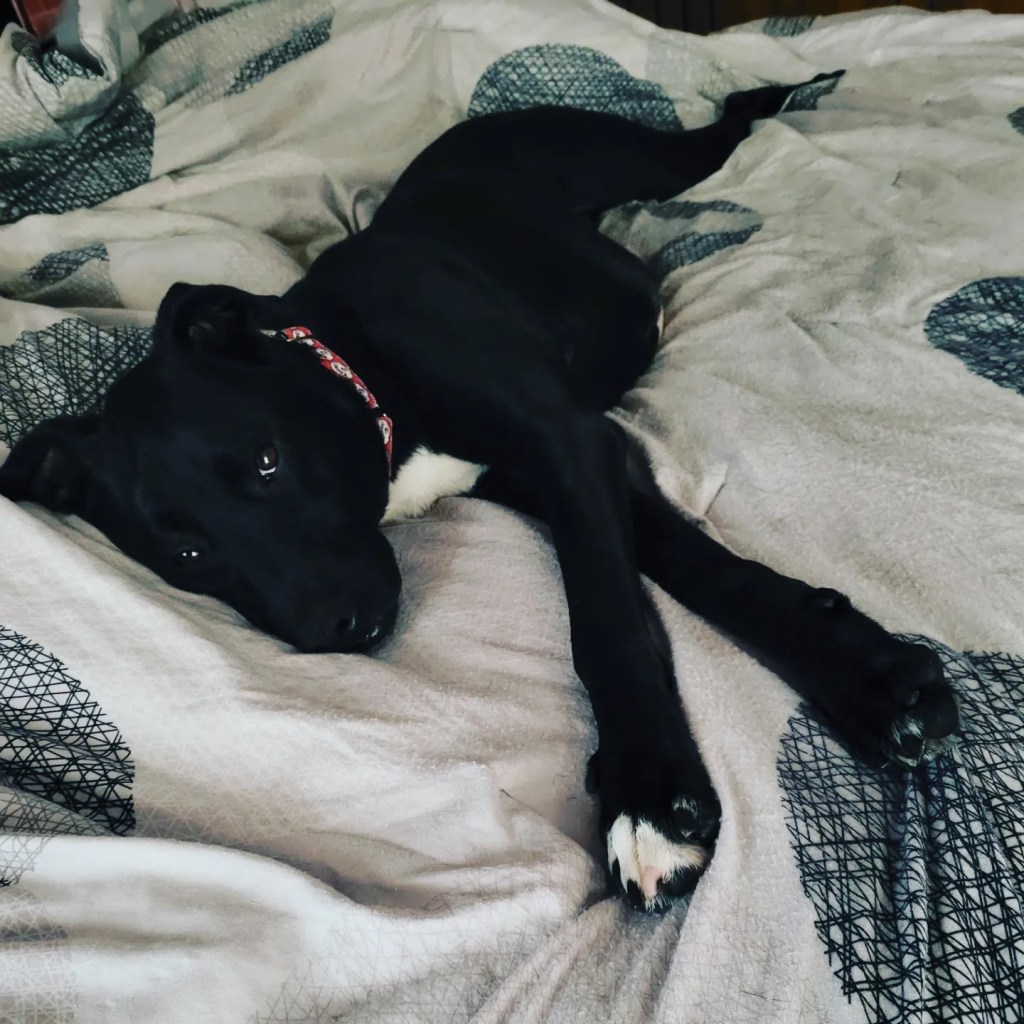
Ziggy’s adoption day photo.
At home, Cookie happily played with Ziggy in the yard and on walksbut pretty much ignored him for about a week inside the house. It never bothered Ziggy, who was content with the attention his pawrents gave. Eventually, Cookie and Ziggy became BFFs, and Cookie proudly settled into her role as Big Sister.
We miss Ziggy every day, but we’re blessed to have loved him for three years.
Cookie and Ziggy shenanigans day 1.
Cookie and Ziggy shenanigans day 1 continuedSisters are nice sofas…Intense game of dentist…Partners in crime!A rare moment of Cookie tolerating cuddles.
Today is the two-year anniversary of Ziggy’s passing. It simultaneously feels like yesterday and 10 years. To commemorate, I want to share my experience with his death, memorializing him and grief.
Knowing when It’s Time
The first time I recall my husband and I talking about the end of Ziggy’s life was driving home from the vet in January or February 2022. I’m fairly certain it was after dropping him off for his splenectomy. Since the mass was found on his spleen and there was a little bit of internal bleeding, we knew we wouldn’t have him much longer, though we’d hoped to have him a couple more months than we did.
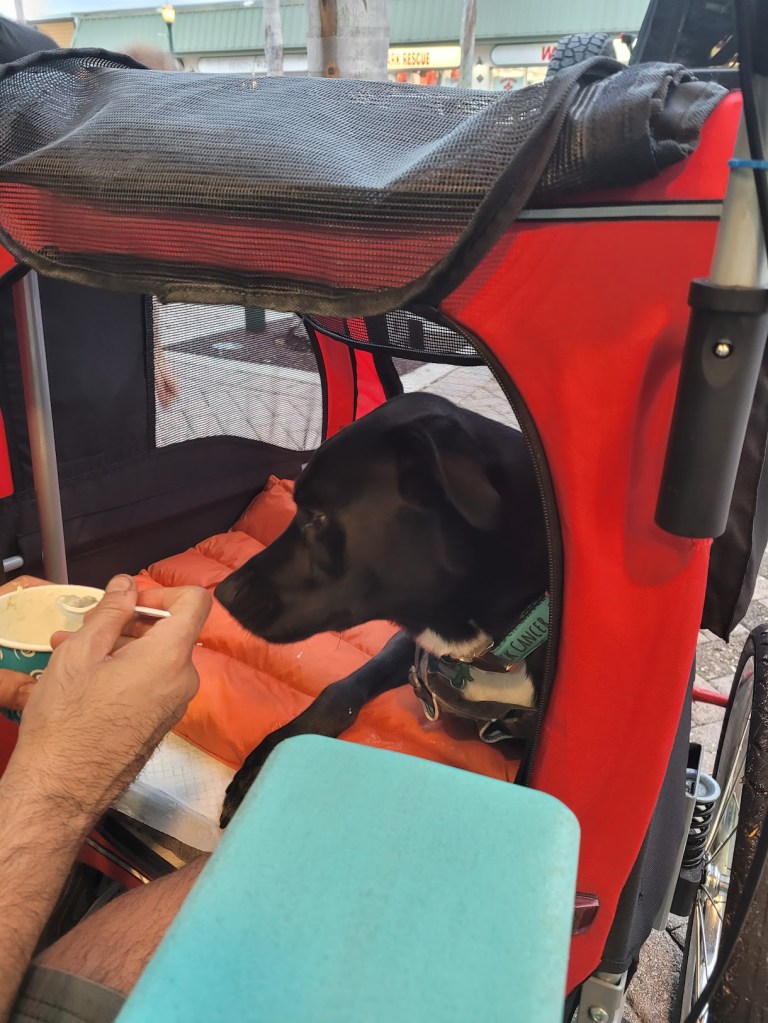
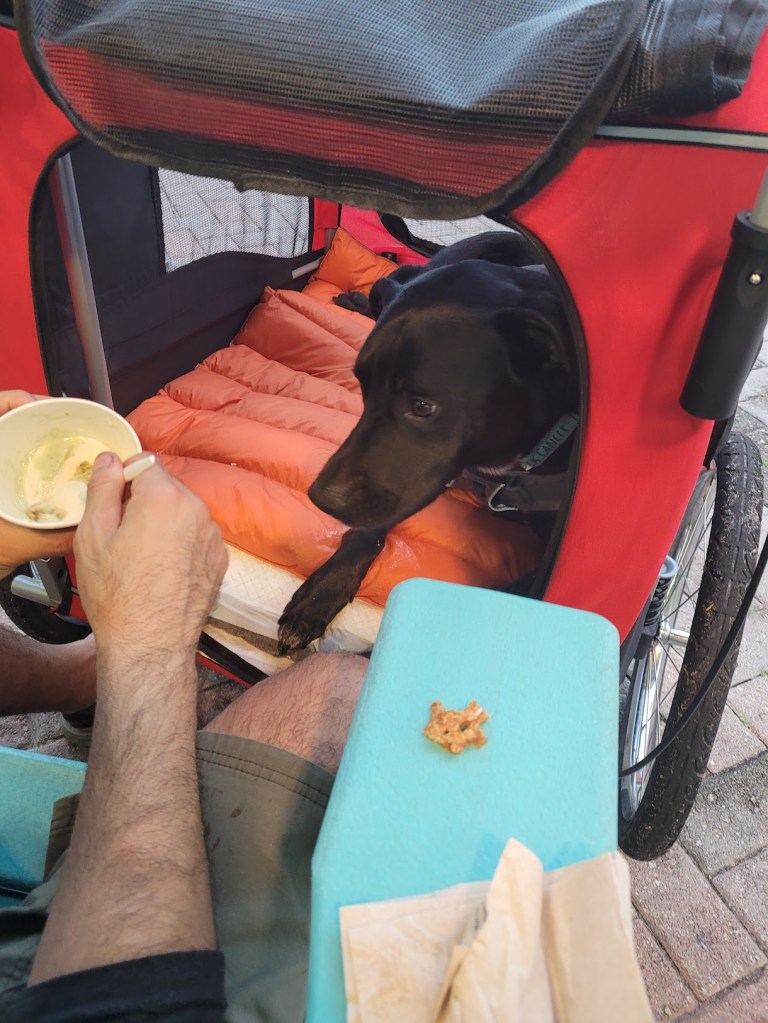
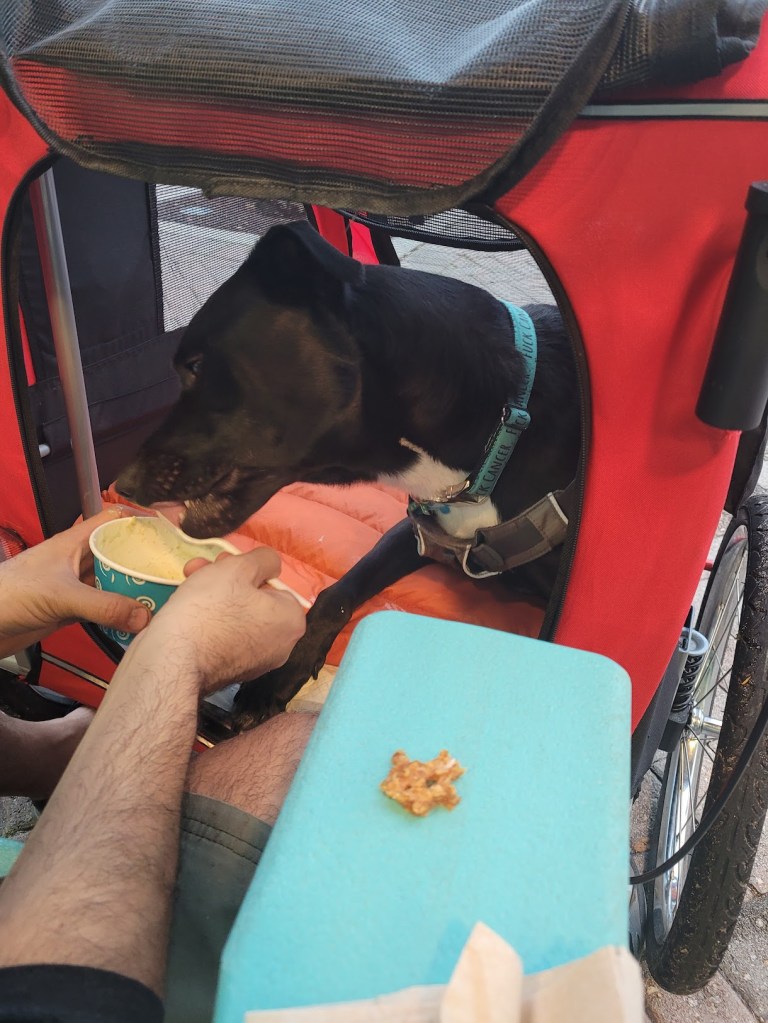
10 days before we said goodbye…Ziggy went out in his stroller for a favorite pastime……a trip to the doggy ice cream store!
We talked about how we’d want to euthanize him. While this was our first conversation, I had done some research at some point during the past year and a half since his diagnosis. I learned about an organization, Lap of Love, that does at-home euthanasia. I immediately knew that’s what I wanted for Ziggy and really any other dog. When I suggested it to my husband, he agreed.
We also talked about what symptoms or signs would be a signal that it was time for us. Fortunately, we were on the same page. Deciding on treatment and care over the next couple of weeks was relatively easy. We talked about it again when he went in for his transfusion and were again easily on the same page. The decisions in the last few days were harder. Especially when Ziggy continued to thump his tail when we came in the room, or he showed interest in going around the neighborhood in his stroller. We both feared the same thing – saying goodbye too soon or causing him to suffer. In the end, we both knew and agreed when it was truly time to say goodbye.
Lap of Love
One of the reasons I wanted Lap of Love is because of Cookie. I wanted her to be present for his death so that she would know what happened. Taking them both to the vet would have been too much. Cookie gets nervous at the vet; we would have been emotional about Ziggy and then stressed about Cookie’s stress about being at the vet.
Additionally, Ziggy went to the vet so much that we really wanted him to be at home and comfortable. We didn’t know it at the time that we had the conversation, but Ziggy was going to be at the vet a lot in the coming weeks. I posted a Ziggy update on March 1, 2022; he had been to the vet eight times since that January. He didn’t need to be going to the vet again on his final day.
2/14/22: An outing to the car wash post stitches removal from his splenectomy2/14/22: After getting his stitches removed and only a few days before he needed a transfusion.
A few days after having the stitches from his splenectomy removed, Ziggy had internal bleeding and underwent a transfusion. He was hospitalized for about 36 hours. When I brought him home, I called Lap of Love for information.
I am so grateful I called then. While it would be a few weeks before we called to schedule his passing, and while he was on the mend when I called, I was an emotional wreck. The person I spoke with that day (and every other time), was incredibly compassionate, a true angel. She answered my questions and took down our information. She was patient and calming through my tears and blubbering.
A few weeks later, when it was time, I just called them and asked for them to come the next day. And then called a short while later to see if they could come that afternoon. Being able to simply schedule it without having to go into Ziggy’s history, personality, or whether there was another dog at the house that day was a relief.
Cookie and Ziggy, exactly one month before Ziggy passed.
We’d hoped to euthanize Ziggy in the backyard, but it was raining lightly when the vet arrived, so we did it in our covered patio. We could have done it anywhere in the house, but Ziggy loved being outside, so we made him comfortable on the patio.
The veterinarian could not have been more sympathetic and caring for all of us. She walked us through what would happen. She took a few photos upon request (that I will never share), and took a paw print imprint. She also told us we could give him any last treats, even chocolate. Ziggy wasn’t interested in the chocolate or even a pupsicle (a favorite treat of his). Up till then, Cookie had been laying quietly, watching, by our side. But, upon seeing Ziggy’s lack of interest in ice cream, she was quick to do her brother a final “favor” and eat his ice cream. Even in death, these pups know how to make us smile.
Once he was gone, my husband and the vet carried Ziggy out in a stretcher, and Cookie, my mom, and I accompanied them. Cookie gave Ziggy a final sniff before his physical body left us too.
Memorializing Ziggy
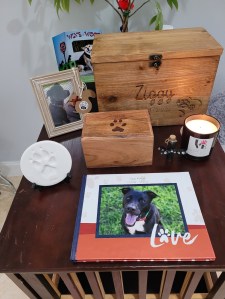
A week or two later, we picked up his ashes at his vet’s. The ashes are stored in a wooden box engraved with his name and paw print. We received another paw print impression and a tiny glass vial with some of his ashes.
Those were part of the memorial space I created for him a top of a wooden crate (used mostly for decoration). I also created a photo book, added a framed photo, purchased a custom box to store mementos from his life, and added a candle.
Ziggy’s memorial space.
The outpouring of love from our community was also incredibly special. The most meaningful was when a neighbor a couple of houses over brought the most beautiful bouquet from her garden. When we first met, she was afraid of dogs generally, and was particularly nervous around our 50 pounders. We respected her boundaries, but with time, Ziggy won her over. She always asked about him, said hi, and one time when my husband was out with Cookie, told him to come back with “the friendly one!” Her gesture meant the world to me because she was once afraid of him.
Grief
The best description of grief is one that a friend shared that compares grief to the waves of the ocean. It’s incredibly accurate. One of the most interesting experiences in grieving Ziggy was watching Cookie grieve. Cookie is a more serious dog, so it was hard at times to know if she was grieving. There were plenty of moments in the days immediately after his passing that I thought I noticed Cookie grieving, but I may have been projecting.
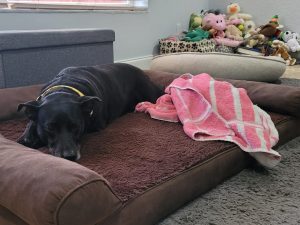
The biggest wasn’t clear to me until three months later. After Ziggy’s amputation, we purchased two large orthopedic dog beds. We kept one in the bedroom and the other in the living room. In the last week or so of Ziggy’s life, he barely left the bed in the living room. (The three of us would rotate sleeping there with him or all stay there with him.) The bed was covered in sheets, towels, and blankets. They were heavily soiled. After he passed, I washed everything twice. Cookie refused to lie in that bed. Even when I swapped the one in the living room with the one in the bedroom, she refused to lie in the one in the living room.
Three months to the day after he passed, Cookie walked over and lay down in Ziggy’s living room bed.
June 12, 2022, Cookie laid in Ziggy’s bed for the first time since he passed.
Final Thoughts
Losing a fur baby is hard. It’s difficult for people who haven’t gone through it to understand how it can be harder than the loss of a human loved one. There’s no right or wrong way, or right or wrong time, to euthanize your furbaby. You may second guess yourself, thinking it was too soon or later than it should have been. You do the best you can. Do not let anyone else influence you. And don’t influence or pressure someone to make the decision the way you would. Every dog is different. What we chose for Ziggy may be different than what we choose for another dog in a similar situation.
Rest in peace, Ziggy. See on the other side of the Rainbow Bridge.
March 3rd (3/3) is Tripawd Awareness Day! While Ziggy was truly a three-legged dog, I managed to unintentionally capture an optical illusion moment.
Years ago, well before meeting my husband, I walked dogs as a volunteer at a local shelter. I was fortunate to have the opportunity to walk a three-legged dog. I was amazed at how happy that dog was – because he was three-legged and in a shelter.
Ziggy and Cookie, December 2021. Photo Credit: Jill Nero
When it was recommended that Ziggy’s hind leg be amputated, it was a hard adjustment, but having seen the joy and ease with which that shelter dog moved on three legs, it was an easier decision than for many.
I was fortunate to have found the Tripawd community online, which helped prepare us for Ziggy’s surgery and recovery. The resources in that community led me to find all of the other wonderful canine cancer and canine health resources I reference today, as well as recommendations for harnesses and more.
If you ever find yourself confronted with the prospect of amputation or adopting a tripawd, I strongly encourage you to turn to this community for support. They are truly priceless!
February is spay and neuter awareness month. You may think you know everything there is to know about getting your pups fixed, but if you’re like me, I’m betting you don’t. There are some commonalities with cats, but never having had cats, I will speak only to dogs. Remember that this post is based on my experience and learning. Be sure to consult your veterinarian or other professionals before making a decision for your pup.
I Didn’t Know Diddly
Until the past two to three years I knew that getting dogs fixed was important in preventing unwanted litters of puppies. With thousands of dogs being euthanized annually due to limited homes and limited space in shelters, spaying and neutering dogs is key to reducing the number of healthy dogs euthanized. I knew that getting a dog from a shelter or other rescue meant that they would be fixed before coming home. While I didn’t know the details of the timing, I did know that dogs from breeders would get fixed months to a year after being brought home.
I never thought much of this, as spaying and neutering is a familiar and routine procedure. I assumed that it only carried the risk that comes with any kind of surgery.
My education
When Ziggy was diagnosed with cancer in late 2020, I began doing a lot of research – attending online conferences and reading articles. I started seeing a lot of references to a link between early spay/neuter and cancer. Many advocated delaying the surgeries until the dogs are around one year old to ensure they get the health benefits of their sex hormones.
While this advice struck me as common sense in retrospect, I was confused. If there was a link between early surgeries and cancer, why did rescue groups opt for early surgeries? In a nutshell: humans are irresponsible and suck.
In March 2022, I attended the Holistic Pet Care Summit. The module with veterinarian Dr. Tara Timpson, who worked at Best Friends Animal Sanctuary, addressed my questions and confusion.
Once upon a time, dogs and puppies would be adopted out without being fixed. The organizations would encourage adopters to return for FREE surgery once the dogs mature to the appropriate age. But the lazy humans DIDN’T follow through on their commitment. While there’s nothing wrong with responsibly breeding dogs, people would be irresponsible with their intact dogs, resulting in unwanted litters of puppies – not enough homes and not enough space in shelter groups.
So the rescue groups were confronted with a choice: do we risk high kill rates of otherwise healthy dogs due to lack of space? Or do we operate on them young, risking illness later in life?
Beyond Cancer
Early spay and neutering is linked to more than cancer.
After Ziggy died in March 2022, Cookie started experiencing incontinence in her sleep. My worrisome brain went straight to cancer. After a couple of tests to rule out more serious illness, our vet advised that the incontinence was likely caused by early spay. While there is medication available to help with incontinence, it comes with its own risks (like all medications). We opted to keep Cookie off of the medication and manage the incontinence with diapers, supplements, and more frequent walks and potty breaks (even in the middle of the night).
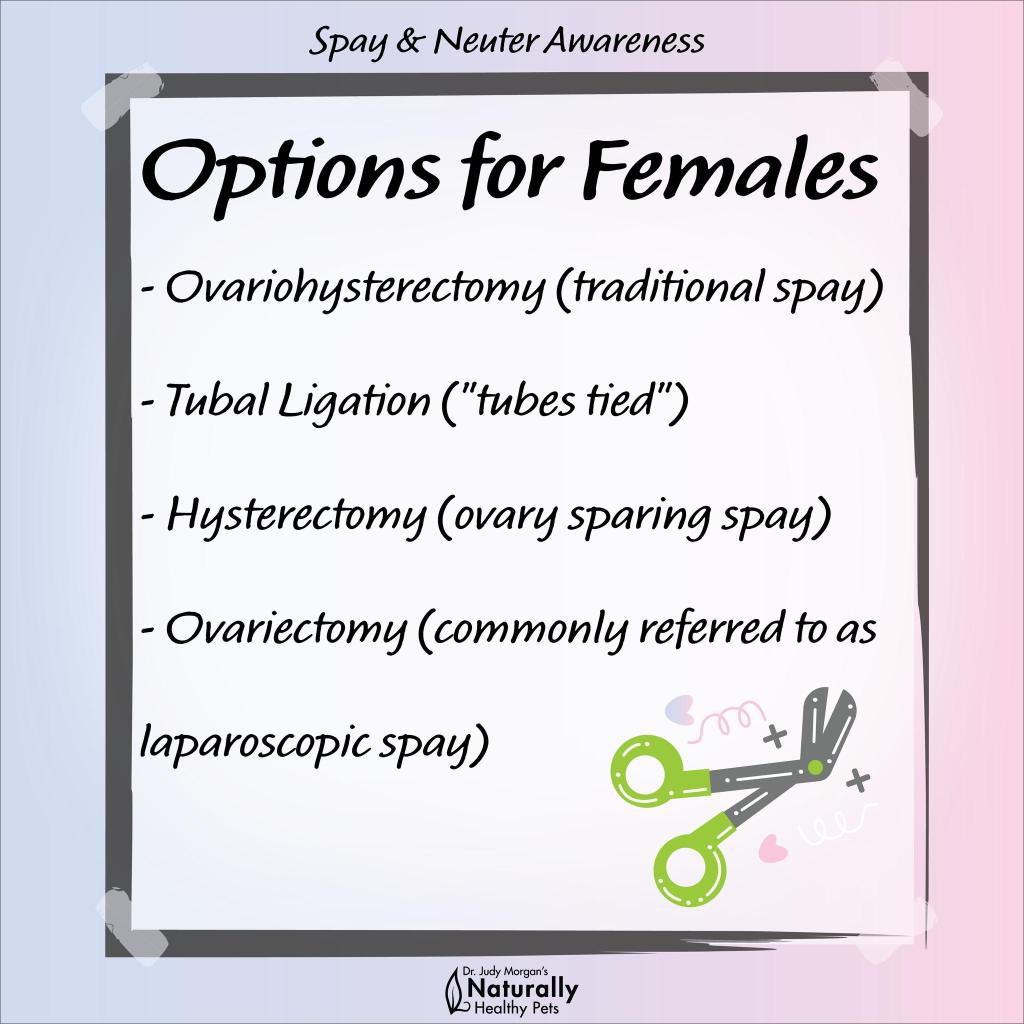
There are multiple surgical solutions for preventing an unwanted litter – two for males and four for females. If you bring an unfixed dog into your home, consult with your veterinarian to consider which option is best for your pup based on age and lifestyle. Each has its own risk factors, so evaluating the options with your veterinarian is important.
If you rescue, you may feel as if you have no options. You could try contacting potential rescue groups to learn what procedure is done on their pups prior to adoption and whether they may be open to letting you choose the procedure. I haven’t tried this, nor have I heard anecdotes from anyone who may have tried it.
You can also work to make changes to veterinary education. Dr. Karen Becker has a petition to include all procedures as part of the veterinary curriculum. On the petition page, you can learn more about the limited curriculum veterinarians receive on spay and neuter surgeries
The Bottom Line
You may not always have a choice in when or what kind of spay/neuter surgery your pup gets, but if you do, evaluate all the options with your veterinarian and decide what is best for your dog. And if you can’t, you CAN advocate for changes in veterinary education, and when
There are many organizations researching aspects of dog health. There are differing ways to participate if you are interested in helping advance canine health and longevity.
Organizations
This is by no means a comprehensive list, but the ones that I have come across in my pawrenting journey.
The Dog Aging Project is a longitudinal study evaluating how your dog’s age. I registered Cookie about a year ago. At the time, I only had the option of enrolling one dog. I don’t recall whether they provided guidelines on which pup to pick or if that was left up to me.
The time commitment is pretty minimal. Upon joining, I filled out a number of surveys about Cookie’s health and lifestyle. Every so often, I receive an email about an activity to do with Cookie and to register the results on their website. You always have the option to skip the exercise, but I always do it because otherwise, it defeats the purpose of enrolling, and it ends up being a bonding activity with Cookie that she enjoys.
The Dog Aging Project aims to extrapolate their findings to humans. Despite aging quicker, dogs experience similar aging issues as humans. Their studies include a medication trial (if you’re local to their facility) and cognitive assessments that you conduct periodically in your home (this is what we do).
Darwin’s Ark brings scientific minds together with pet parents to help study the effects of the environment on our furry companions. They have several projects, but the one that appealed to me was their cancer project.
You can register more than one dog, participate by filling out surveys, and even submit your dog’s DNA. You can purchase a kit or be added to the waitlist once you complete a minimum number of surveys to obtain one for free! (I have yet to reach that minimum.)
Take C.H.A.R.G.E. is a canine health registry and exchange. That simply means that veterinary clinics and dog pawrents can upload the medical records of dogs with cancer. The records are anonymized, and the data surrounding dogs with cancer is available in a dashboard.
When I signed up, I was able to upload the medical information for both Ziggy and Cookie. It was simple to do, and there hasn’t been any additional action needed or requested from me.
The American Kennel Club is involved in all things dog and has its own foundation. The AKC Canine Health Foundation funds scientific research centering on canine illness. You can contribute to the organization, read about the outcomes of studies, or even participate in research.
I don’t have any experience with participating in research studies. Whether or not it makes sense for you requires careful consideration of several factors such as the criteria of participation, your financial situation, whether covering the cost of care is included, comfort with the risk of getting a new treatment, comfort with the risk of getting a placebo treatment, etc.
Considerations
Participation with these organizations or others boils down to your comfort level, the time commitment, and the risk-benefit analysis for your particular situation. Everything other than the research studies seems to have no risk and low time commitment, but it’s ultimately up to you to decide.
Now that you know that there are so many dog sports to choose from, how do you pick?
General Research
Reading about the experience of other pawrents, or talking to friends with experience in dog sports, can be one way to familiarize yourself with the sport. So can watching YouTube videos of classes or competitions.
The websites of the various venues can also provide a wealth of information, including connecting you with dog clubs in your area that host competitions and/or classes.
Here are the websites of various groups I’ve referenced this past month.
Ziggy and Cookie waiting their turns in an agility class, circa 2019.
Research dog trainers or dog clubs in your area. Sign up for classes to better gauge what the sport will entail long term. If you take a class and the sport interests you, but you’re unsure, consider trying classes with another instructor. Everyone has different teaching styles and personalities. Look for someone you’re comfortable with and that prioritizes the well-being of your dog.
Assess Personality & Interest
Cookie at a CPE agility competition in March 2019Ziggy competing in Barn Hunt instinct 2019. Credit: Pix N PagesChip goofing off at graduation time for his CGC certificate, November 2023
A good place to begin is assessing you and your dog’s personalities and interests. Is your dog high-energy? Agility may be a great fit. Does your dog have a knack for sniffing? Perhaps barn hunt or nose work would interest them. Can’t keep your pup out of the pool? Give dock diving a try!
If you recently adopted your dog, or perhaps your dog is still a puppy, you may not know their interests. Obedience is always a great place to start, even if you don’t compete, because obeying basic commands will be important in any sport, if for no other reason than good behavior in classes and competitions.
Safety
Safety and physical well-being is also important. This may be true of all sports, but the one that I’m most familiar with is agility. The high speeds, twists, and turns can put a strain on your dog’s body. If you’ve never used any agility equipment before, don’t introduce your dog to them without guidance from an instructor. Young pups are developing their bones and muscles. Introducing them to tight weave poles too young can cause long-term damage. This is an excellent article about preventing orthopedic injuries in dogs that compete in sports.
Budget Considerations
Depending on your goals for your dog, some sports are more expensive than others when you add up classes, entry fees for competitions, travel expenses, and any equipment you may choose to purchase for at-home training.
Start slow and make sure you want to commit to the sport before investing heavily.
Bottom Line
There countless canine sports available to try. Take your time to find one that best suits you and your pup. And, remember, the competition and titles are a distant second to having fun and bonding with your pup!
This week, I’m touching on several sports. A couple of them we have some experience with, while others we have only heard of. As always, this is based on my knowledge and experience with the sport (more limited than usual), and I encourage you to do your own research.
Tricks
Are you familiar with videos of dogs performing silly activities or even dancing a whole routine with a human handler? Well, that’s what the American Kennel Club’s Trick Dog title is all about.
Similar to other AKC sports, tricks have multiple levels in which you can title. In our experience, it’s not a competition like agility but a test like Canine Good Citizen (CGC). Some dog clubs will host classes where you learn a variety of tricks for the given level. Other times, they only offer the test, and it’s up to you to train your dog.
The qualifying tricks at the novice level are mostly your basic obedience commands. In fact, if your dog has their CGC certificate, they only need to perform five novice tricks to earn their novice trick dog title!
Cookie earned her advanced trick dog title virtually during the pandemic. Depending on your patience and motivation, you may plan to train certain tricks but pivot to others depending on how easily your dog picks up the tricks. I did that with Cookie at the more advanced levels, and also with Ziggy.
Cookie earned her advanced tricks title virtually in 2020.
Nose work
Several years ago, we did an introductory nosework class with Cookie. The aim is to train your dog to find certain scents that are hidden. Training starts with finding the scents within boxes and progresses to scents hidden elsewhere in a course. This class was harder for Cookie. Since none of us enjoyed it much, we didn’t pursue it further.
During Chip’s reactive dog class, our instructor shared that nose work is an excellent activity for reactive dogs. In our last class, they showed us how to introduce the concept using boxes and treats. While Chip did OK in class, when I tried at home he was afraid of the boxes! I hope to dig up some patience and try again, consistently, with him because I really do think he would be good at this (and enjoy it!).
Since my experience is incredibly limited, I don’t know anything about how competitive nose work operates. The National Association of Canine Scent Work is a great resource to learn more.
Tracking
Similar to nose work, we only did one class in tracking with Cookie a long time ago. She did well and seemed to enjoy it, but classes were a bit far and offered infrequently, so it was hard to keep up with.
Instead of searching for specific scents, in tracking dogs search for dropped articles outdoors. Tracking is another AKC sport. It’s non-competitive and simply a test with different levels.
Rally
Once again, rally is an AKC sport. We have never tried this with any of our dogs, but it’s one that I contemplate trying with Cookie since she’s a senior dog and the most obedient of all our dogs.
From what I’ve observed, rally is similar to agility in that there is a set course, but instead of obstacles, you stop and do various obedience actions at each “stop” on the course.
While this appeals to me for Cookie because of her age and the fact that she’d crush it, it appeals to me with Chip as it’s an opportunity to practice obedience, but in a new light.
Dock diving
I have never considered dock diving with any of my dogs because they all hate water! Dock diving is exactly what it sounds like – dogs jump into a long pool. The farther they jump, the better. While a Google search showed that there are multiple venues that offer dock diving, North American Diving Dogs is the organization that a friend and mentor has taken her pool-loving dogs to compete in.
To my knowledge, training involves having your dog jump in your pool. Cookie is the closest to a swimmer that we’ve ever had. She can be bribed to step (yes, step) into our pool and swim a semi-circle. If there are no high-value treats involved, she will not step a single paw into the pool.
Cookie swimming a lap in 2021, with Ziggy keeping a protective eye on her.
The Bottom Line
As you can see, there’s a dog sport for everyone. I know that the sports that I’ve written about are just the tip of the iceberg. There are sports involving frisbees, farming (perhaps that’s herding?), and more. Finding a sport that both you and your dog enjoy will help strengthen your bond and be a more effective and healthy outlet for them to tire out their body and mind.
Next week, I’ll share some advice on how to find the dog sport that’s right for you.












 pawrentingtails.com