Lessons from Chip

He may be dog number three and has only been here for a little over a year, but Chip has already started teaching us so much – and reinforcing previous lessons.

3-3-3 Rescue Rule

Long before bringing Chip home, I learned about the 3-3-3 rescue rule. In a nutshell, it says that rescue dogs need three days to decompress, three weeks to learn your routine, and three months to feel at home.
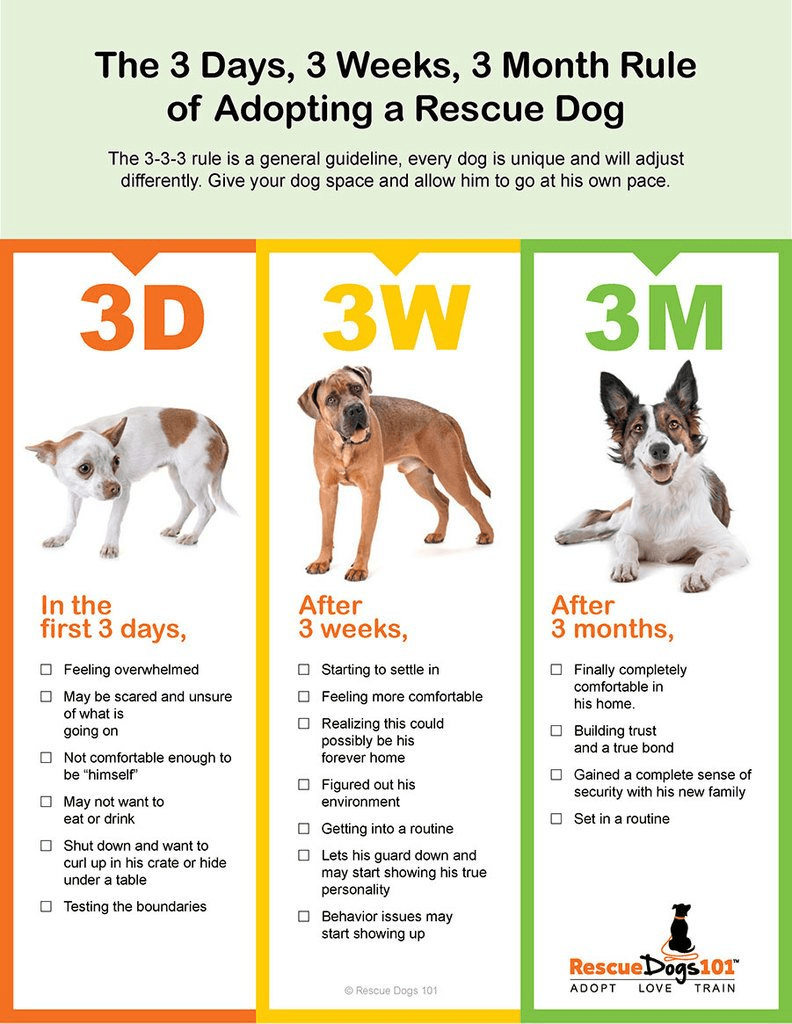
Infographic depicting the 3-3-3 rescue rule
Credit: RescueDogs101

It’s a general rule and not something that applies consistently across all rescues since every dog is different! When I first heard of this “rule,” it made perfect sense, though it didn’t seem to apply quite exactly with Cookie or Ziggy. They adjusted more quickly.

Meanwhile, this has fit Chip very well, but he’s probably taken a little longer with each phase. So far, Chip is our most challenging dog and can cause more frustration. BUT, it is SO rewarding to see how far he has come. Part of it is natural growing up, another part is continuing to adapt to a safe, loving, and stable environment, and yet another part is us figuring out and meeting his needs (i.e. sufficient enrichment and exercise).

This approximate timeline is important to consider when deciding to rescue. Be prepared to invest the appropriate amount of time before your new pack is running smoothly. Each dog will be different based on their history (which the degree of known detail will vary based on the circumstances they were found/surrendered) and their individual personality.

Bottom line: Be patient. Work with your pup and seek out professional trainers to help your pup adjust.

Barking is trainable
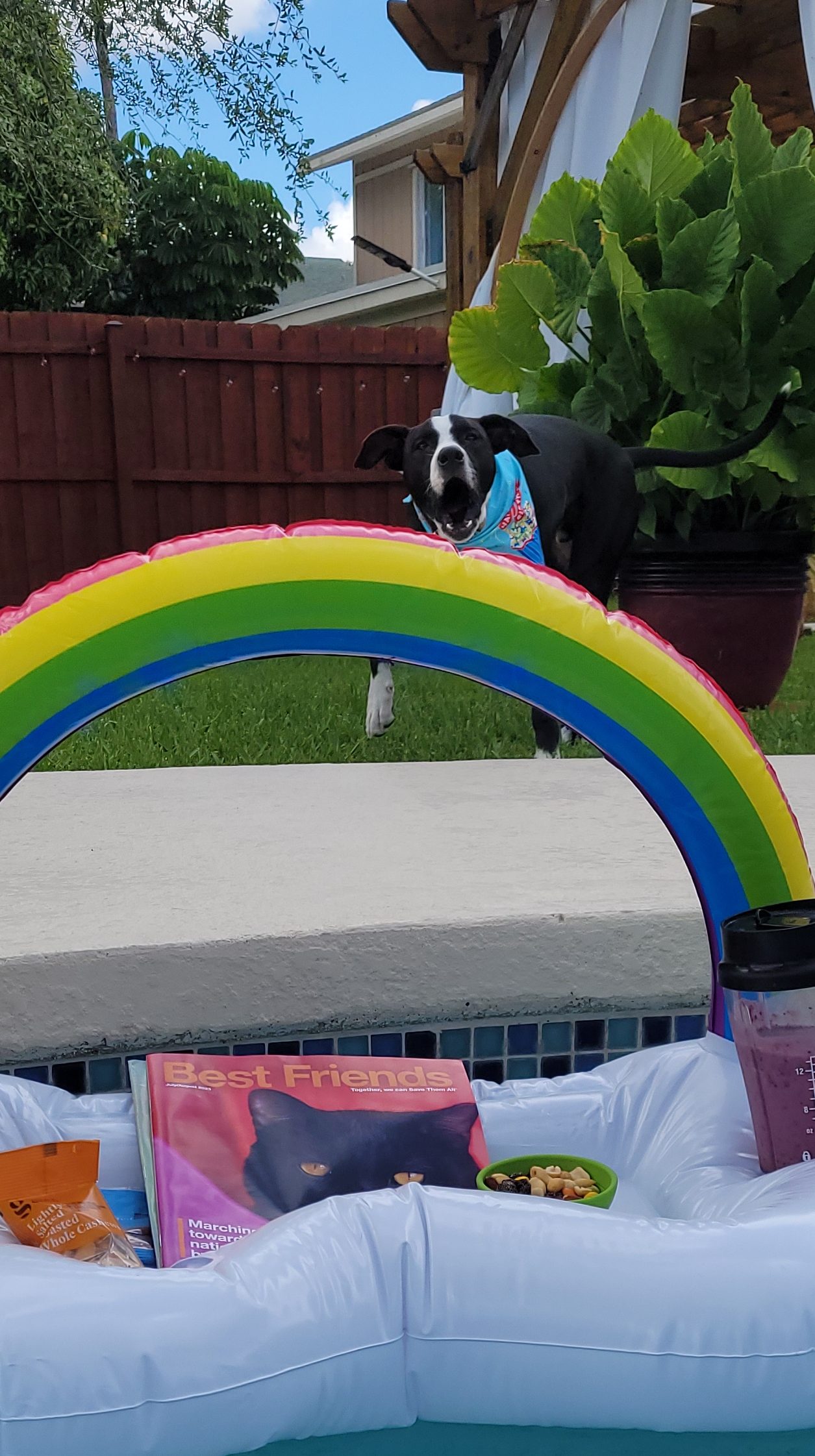
Chip barking at a pool float.

Cookie and Ziggy are not avid barkers. Sure, they’d bark if a delivery was being made or “suspicious” people walked past our house. But that was mostly it. Any other time they needed to communicate they would use their eyes or body language.

Not Chip. He is a “chatty Cathy.” While I believe that’s partially due to him having husky in him, it’s also been reinforced one way or another. Barking is a form of communication, and while we may not agree with the importance of why they’re barking, dogs are trying to communicate something when they bark.

For example, when I would shower and get ready for work, I would crate Chip in our bedroom just outside the master bath. At first, he would bark non-stop. Fortunately, I was able to be in his line of sight if I left the door open. So, when he was quiet, I would reward it – with LOTS of verbal praise and treats, when I could.

He quickly learned that I was nearby and that he didn’t need to narrate the entire time I was in the shower.

Other scenarios are harder to train (though professional trainers are more likely to offer up better tools than me), but with time they’re doable. In the beginning, for many reasons, we would walk Cookie and Chip separately. We couldn’t always ensure that one of us was home with Chip while Cookie would get walked. So he was crated, and for Cookie’s 20-minute walks, Chip would bark almost non-stop.

Over time, he grew more confident that he wasn’t being abandoned and that we always came back. We also slowly started testing the waters leaving him uncrated during her walks. Thankfully, those experiments were successful, and the combination of time and being uncrated worked for Chip.

Bottom line: The key with barking is to make sure you reward the silence, not the barking – particularly in scenarios where the barking isn’t appropriate. Barking is a natural dog behavior and shouldn’t be eliminated, simply managed. Find professional trainers that can help you modify the behavior.

Reactivity isn’t a bad word

Before Chip, “reactivity” had a bad connotation for me. I took it to mean an aggressive, unapproachable, unsocial dog. But it’s not.

Reactivity is simply a dog responding to stimuli in the environment. It could be for a multitude of reasons including overexcitement and fear.

One account that does a great job educating and bringing awareness on reactivity.

I’m still learning how to best support Chip and set him up for success. Sometimes his reactivity is clearly fear, and other times excitement. Those are his main drivers, but there are other times when it’s hard to tell.

We’ve taken a training class specific for reactive dogs, and I continue to learn by following experts such as Dynamite Dog Training (one of several of Chip’s teachers), r+dogs, and Dog Training Academy Florida.

Bottom line: Be open to the “reactive” dog label. Whether your dog is reactive or not, I encourage learning more about reactive dogs because it can help you support pawrents of reactive dogs when you encounter them.

Life lesson: Stay tuned

Chip showing off "peek a boo" in his Canine Good Citizen class.
Chip showing off “peek a boo” in his Canine Good Citizen class.

One year in is too early to pick Chip’s life lesson, so you’ll have to stay tuned as he grows up to see what else he teaches us!
Cookie’s Lessons

All of my pups have taught (and continue to teach) me a lot about being a Dog Mom. Here are the top lessons from Cookie, my first teacher.

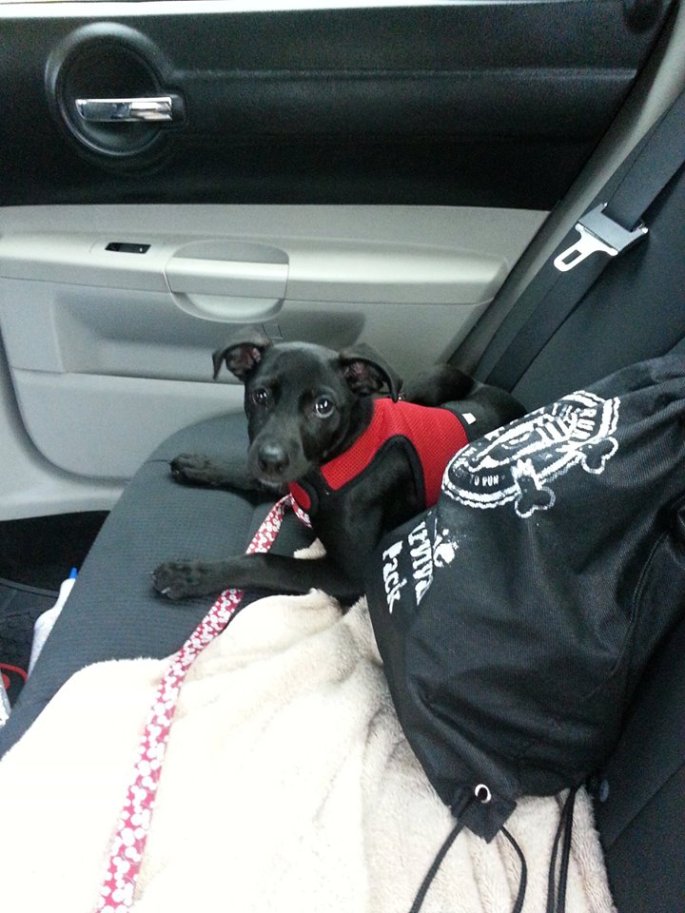
Puppy Cookie en route to her first class 9 years ago.

Dogs don’t Equal Instant Friends

When we first brought Cookie home, I expected to meet and become friends with a bunch of other dog pawrents in the neighborhood. That’s a big fat NOPE!

At first, I thought these other dog owners were just rude. With time, I realized there’s more than meets the eye.

For starters, not all humans are social (duh!). And, just because they have dogs, doesn’t mean they’re interested in befriending other dog pawrents. I was more interested in meeting people back then. Now, I look forward to buying gear like this:

More importantly, they’re likely looking out for the well-being of their dog. Their dog may be anti-social, nervous/reactive around new people/dogs, or could be recovering from an illness and not interested in saying hi. Better yet, they could be training their dog not to go up to every person or dog that crosses their path (something I’m working to correct with Chip!).

Bottom line: Don’t expect everyone to want to do a meet and greet or want to become friends. That’s true even if you’re out at a public event. They really may just want to bond with their dog competing in dog sports, or maybe they’re focused on training or socialization.

Dog parks are a recipe for trouble

This one may surprise you, especially those who knew us in Cookie’s puppyhood. We took Cookie to dog parks regularly. At the time we didn’t have a fenced yard, so we did it for exercise in addition to socialization, playtime, and bonding. We would occasionally meet up with friends who also had pups.

Over time, we started to encounter challenges. At the park closest to home, the humans became problematic. Some wouldn’t pick up after their dogs, so the rest of us would be left to hope that our pups wouldn’t step in, roll on, or eat (yes, eat) the poop. Thankfully, that never happened with Cookie, but was a legit fear when I’d observe people ignoring their pooping pooches.

Many would also not properly supervise their dogs, intervening when body language indicated displeasure or stress. Any time I observed this, in Cookie or others, I was quick to cut playtime short. (She’d often run up to me, telling me she was ready to go.)

Another challenge can be the size and number of dogs in the park.

The dog park closest to home at the time had three areas for different-sized pups. However, many regulars would get everyone together regardless of size. As a puppy, Cookie LOVED playing with all dogs, especially the larger ones. Then Cookie had an accidental run-in with much larger dogs.

At the local park, there was more flexibility in what dog groups you engaged with, but sometimes it was all or nothing. Another dog park further away had a different set-up: one section for small and another for big dogs.

We would often meet up with a friend and her pup (Annabelle), the same age as Cookie, at the second park. They were too big for the small dog section but significantly smaller than most of the dogs in the big dog section. For a long while, that park worked well for us. It was spacious with plenty of space for different groups of dogs to interact. Cookie and Annabelle however, often preferred each other’s company to that of other dogs.

One day while Annabelle’s mom and I were talking, I heard a loud yelp that I knew belonged to Cookie. She was physically OK but shaken up after a couple of larger dogs accidentally ran into her. We went home after that, but later walking in our neighborhood she was wary of some other dogs that she previously had been friendly with.

Fortunately, she got over it, but it was the beginning of her trust in other dogs waning, especially larger ones. Even now she is happier saying hi to the small dogs.

Bottom line: dog parks can be fun, but there’s a lot of opportunity for trouble – beyond the ones that we experienced. You’re better off scheduling play dates with the dogs and humans you know and trust. If you or your friends don’t have a yard, there’s a cool service where you can rent private “dog parks” (aka backyards). I’ve never tried them before, but Sniffspot may be worth a look!

A look is worth 1,000 words

Each of my dogs have different communication styles. Had dog buttons been popular when Cookie was a puppy, I’m sure she would have taken to it quickly. Now, I’m pretty sure her disinterest is due to knowing that one look from her gets her what she wants 99% of the time.

What also impressed me is how Cookie will try different ways of asking for something if we don’t understand the first time. For example, when Cookie was still potty training and we were learning to understand her cues there was a time that she had been more energetic (the equivalent of the human “I gotta go!!!” dance) that we chalked up to puppy energy. Cookie ran to our bedroom, brought a dirty sock from the hamper, and dropped it in front of me. And stared at me. She never did that before. When I asked her if she needed to go out, her reply was an emphatic, “FINALLY! YES!!!”

Since then, Cookie helped to potty train both of her brothers. They were both harder to interpret the play as needing to potty. So, when she knows better, she asks to go out, then when her brothers walk outside, she asks to go in. And soon the brother in question pees.

Bottom Line: Anyone who thinks dogs don’t understand us has clearly never paid close attention.

Crate Training

Cookie taught us the benefits and importance of crate training, but three dogs in and we’re still learning how to do it right.

Neither my husband nor I had experience with crates before Cookie, and we didn’t want to confine her too much on days she had to be alone with both of us at work. Given the set-up at that first apartment, we used baby gates to confine her to the kitchen and foyer area.

Let’s just say that the stories of Cookie’s escapes and troublemaking in the five months she lived at that apartment could fill an entire post. Beyond using crate training for potty training (and training in general), having a pup that is comfortable in a crate is beneficial if they ever need to spend time in one at the vet, groomer’s, during dog sports/classes, or at a shelter if you ever have to evacuate for a natural disaster. While Cookie has adapted well to those situations, it has more to do with luck and her general temperament than anything we did.

Life Lesson: Ask

Finally, Cookie’s life lesson: if you don’t ask, the answer is always no. Cookie is a master negotiator. She has gotten more treats and attention simply by asking.