Now that you know that there are so many dog sports to choose from, how do you pick?
General Research
Reading about the experience of other pawrents, or talking to friends with experience in dog sports, can be one way to familiarize yourself with the sport. So can watching YouTube videos of classes or competitions.
The websites of the various venues can also provide a wealth of information, including connecting you with dog clubs in your area that host competitions and/or classes.
Here are the websites of various groups I’ve referenced this past month.
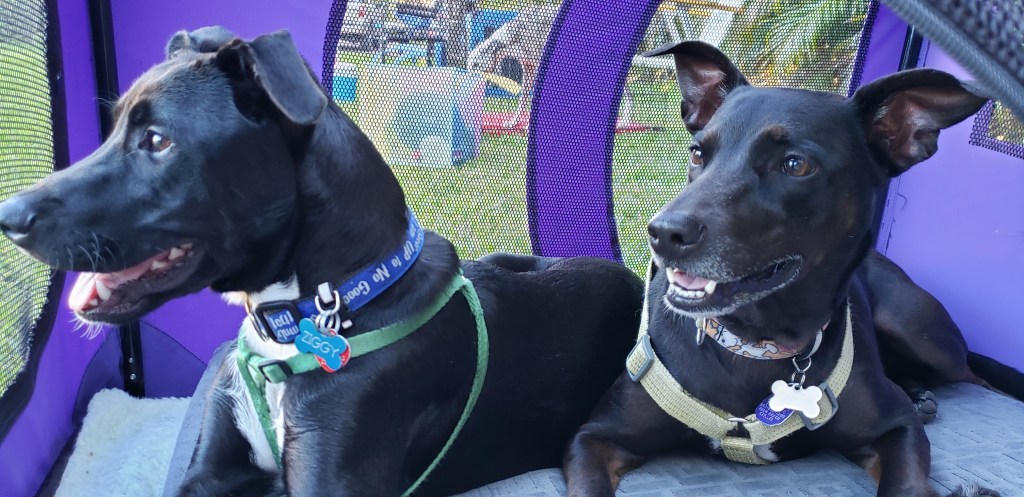
Ziggy and Cookie waiting their turns in an agility class, circa 2019.
Research dog trainers or dog clubs in your area. Sign up for classes to better gauge what the sport will entail long term. If you take a class and the sport interests you, but you’re unsure, consider trying classes with another instructor. Everyone has different teaching styles and personalities. Look for someone you’re comfortable with and that prioritizes the well-being of your dog.
Assess Personality & Interest
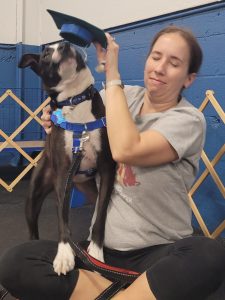
Cookie at a CPE agility competition in March 2019Ziggy competing in Barn Hunt instinct 2019. Credit: Pix N PagesChip goofing off at graduation time for his CGC certificate, November 2023
A good place to begin is assessing you and your dog’s personalities and interests. Is your dog high-energy? Agility may be a great fit. Does your dog have a knack for sniffing? Perhaps barn hunt or nose work would interest them. Can’t keep your pup out of the pool? Give dock diving a try!
If you recently adopted your dog, or perhaps your dog is still a puppy, you may not know their interests. Obedience is always a great place to start, even if you don’t compete, because obeying basic commands will be important in any sport, if for no other reason than good behavior in classes and competitions.
Safety
Safety and physical well-being is also important. This may be true of all sports, but the one that I’m most familiar with is agility. The high speeds, twists, and turns can put a strain on your dog’s body. If you’ve never used any agility equipment before, don’t introduce your dog to them without guidance from an instructor. Young pups are developing their bones and muscles. Introducing them to tight weave poles too young can cause long-term damage. This is an excellent article about preventing orthopedic injuries in dogs that compete in sports.
Budget Considerations
Depending on your goals for your dog, some sports are more expensive than others when you add up classes, entry fees for competitions, travel expenses, and any equipment you may choose to purchase for at-home training.
Start slow and make sure you want to commit to the sport before investing heavily.
Bottom Line
There countless canine sports available to try. Take your time to find one that best suits you and your pup. And, remember, the competition and titles are a distant second to having fun and bonding with your pup!
Second up for National Train Your Dog Month is agility!
As always, these posts focus on my knowledge and experience of the sport. Consult the various links in the posts for more information.
Full disclosure: I never competed in agility with any of our dogs. It was my husband’s sport with Cookie. I served as their manager, photographer, videographer, cheerleader, and backup handler.
What is it?
Agility is essentially an obstacle course for dogs with a specific sequence that you lead your dog through, and where accuracy and speed matter.
Each venue has different levels of competition and different rules. The obstacles may vary but generally include jumps, weave poles, teeter, dog walk, A-frame, table, and tunnel. The obstacles are laid out in a specific sequence. Handlers have the opportunity to walk the obstacle course for a few minutes before the competition begins.
While the obstacles are numbered to guide you, walking the course allows you to learn the course so you can focus on staying ahead of your dog and directing them accordingly during the competition.
Walking the course also lets you think through the types of signals you’ll give your dog to run the course completely.
How we started
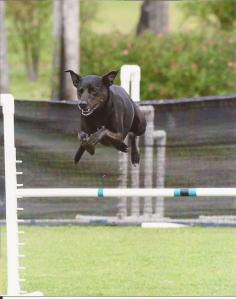
Cookie going over jumps in a March 2019 agility trial. Credit: Robin T Brumfield Photography
Last week, I talked about how we started obedience at a shelter near our home. Cookie’s initial classes were outside in a fenced-in field. One week, there was an agility class being held in the field next to us. My husband watched through the chain link fence, looked at me, and said, “We should try that!”
I pretended to ignore him until one of the obedience instructors, also a member of the canine sports club that held agility classes on that field, approached us and said that Cookie would do great in agility. So, I jotted down the name of the group and signed us up for an intro to agility class.
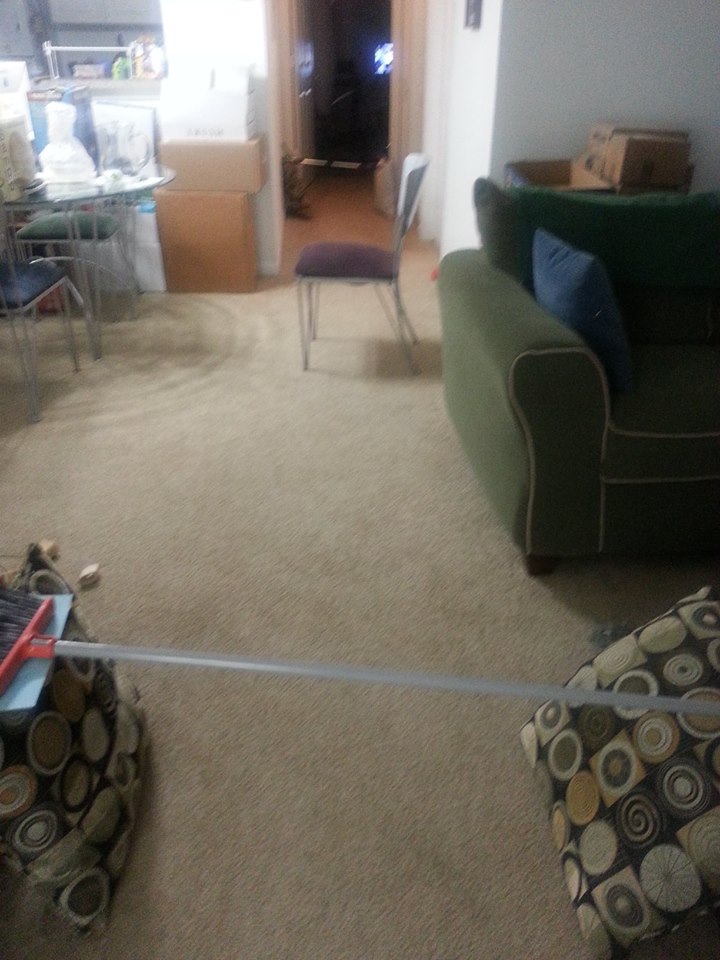
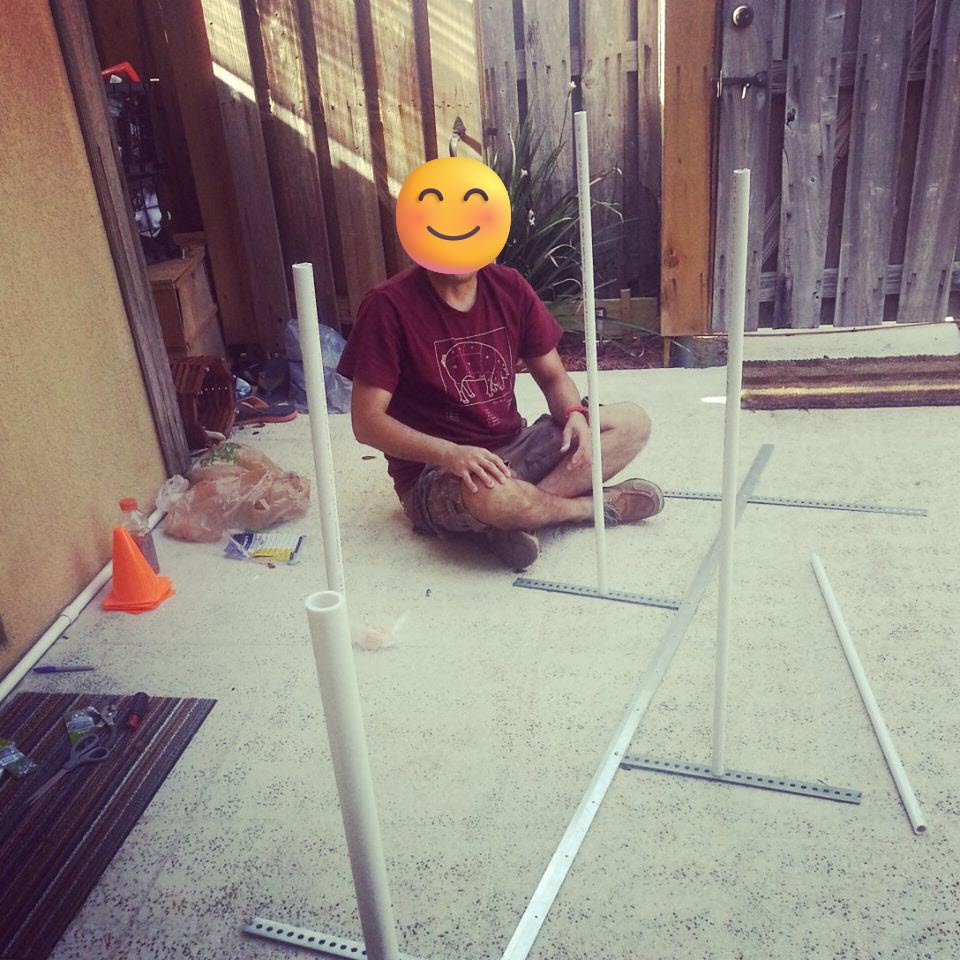
Before we actually started, and while we still lived in an apartment, my husband started practicing agility with Cookie indoors. When we moved into a townhome, he built some basic jumps and weaves for practicing with Cookie at home.
Our makeshift agility course in our apartment.My husband building Cookie a set of weave poles.
We took classes for at least a year before entering Cookie in her first agility competitions. It probably took her roughly a year of competition before her brain “clicked,” and she started sailing through the competitions.
What they don’t tell you
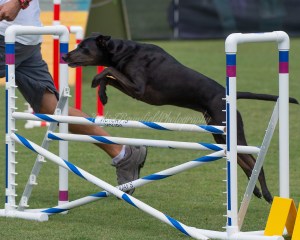
Cookie flying over a jump in a 2019 CPE agility trial. Credit: Robin T Brumfield Photography
We were fortunate to have great agility instructors and a community when we first started. Thankfully, most of this was told to us, but sometimes it takes you experiencing it for yourself before the lessons really sink in.
Most of the work is on you
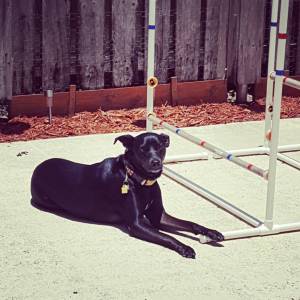
Cookie, circa 2015-2016, practicing agility through osmosis.
This is one that was truly surprising, but validated when I would record Cookie’s classes in addition to competitions. Once your dog knows the obstacles, most of the work is on you. It’s up to you to know the course, be far enough ahead of your dog (spoiler alert: you can’t outrun your dog no matter how in shape you are), and ensure your whole body is giving your dog the same direction.
Record your runs, and you’ll find that when your dog goes the wrong way, 97% of the time, your body language is sending mixed signals. Your feet, torso, and hands need to all be pointing in the same direction.
Different Venure, Different Rules
While the basics of each obstacle will be the same across venues (i.e., AKC, USDAA, CPE, etc.), the specific rules may vary. For example, in one venue, the table obstacle doesn’t care which position the dog is in, while another requires the dog to sit or lie down.
Similarly, other rules about competition (i.e., whether they can wear a collar or must run “naked”) may vary by venue. If you’re taking classes with an instructor who is experienced in multiple venues, they’ll likely point these nuances out during classes. A recommendation from our instructors was to train with the more conservative rule (i.e., train your dog to lay/sit in a position for all venues).
Even if they do, you’re liable to forget before your first competition (or get them all mixed up). You can research rules ahead of time. Day of competition – be sure to be present for the judges briefing at the start of the day (usually an overview of trial-level rules) and, more importantly, in my opinion, the briefing happening for each specific class. Since judging may be more critical at higher levels, they’ll go over what counts as a fault at the start.
Don’t let your first competition be your first trial
The best way to know what to expect at your first competition is to go to trials before you start competing. You can take your dog to expose them to the chaos of a trial (lots of dogs in crates, loads of baring, speakers, and buzzers).
Observing the routines of the briefings, learning your dog’s results, and more are incredibly beneficial.
Even better than observing: volunteer. All of the trials we’ve been part of have required volunteers. Without volunteers, the competition can drag on and be a worse experience for all involved. Most of the volunteers are likely competing as well, so they may not be able to do set jobs for the whole trial.
Doing so can really set you up for success. I remember that we briefly went to one or two trials, but we purely sat on the sidelines at first. I’ll never forget at our first trial, in between runs, one of Cookie’s instructors came up to me asking how she did. I had no idea. Thanks to her dragging me off the bleachers, I learned that there’s a table where the results get shared. I might have been waiting for results to this day if not for her kindness. Had we been more involved as volunteers before competing, this is something we likely would have learned in advance.
Dogs just wanna have fun
Cookie at an agility practice with her substitute handler (aka me) in September 2019.
Most important: JUST HAVE FUN!! Agility is fun and a great bonding experience. Even if you dream about competing in national or international competitions, fun, and bonding must be at the center of every activity.
Start trialing before your dog is perfect in class. Cookie was incredibly food motivated, and in the beginning, she would constantly jump at my husband’s hands looking for her payday (in class). Treats aren’t allowed on courses, but she repeated that same behavior for a while. It’s something we had to work on with her before something finally clicked in her brain, and she truly started looking (and competing) like an athlete.
Throughout all of the classes we took with Cookie, the common refrain I heard: the tunnel is puppy crack. Once it was taught, few classes would ever include a tunnel in the course because it was so addictive for them.
This isn’t true for all dogs. While Ziggy never got to compete in agility, I taught him to tunnel for barn hunt with an agility tunnel. I tried the same approach for Chip in barn hunt. He was not having it! Tunnel has taken a lot more effort with Chip (and I haven’t kept up with practice with him). He’s made terrific progress with it, but it didn’t translate to his first barn hunt trial last year.
The bottom line
Agility isn’t for everyone, human or canine. I went to all of Cookie’s classes, recorded them, and would often critique my husband. Then, I became his stand-in when he had work conflicts. Agility is much easier from the sidelines.
Even if both you and your pup fall in love with the sport, it can be rough on their bodies. Take the advice of instructors seriously and ensure you know how to teach an obstacle before letting your dog try it out.
Have fun! Agility was our home in the dog sports world for a long time. While there can be just as much drama there as in other areas of life, it was a mostly positive experience.






 pawrentingtails.com