Lessons from Chip

He may be dog number three and has only been here for a little over a year, but Chip has already started teaching us so much – and reinforcing previous lessons.

3-3-3 Rescue Rule

Long before bringing Chip home, I learned about the 3-3-3 rescue rule. In a nutshell, it says that rescue dogs need three days to decompress, three weeks to learn your routine, and three months to feel at home.
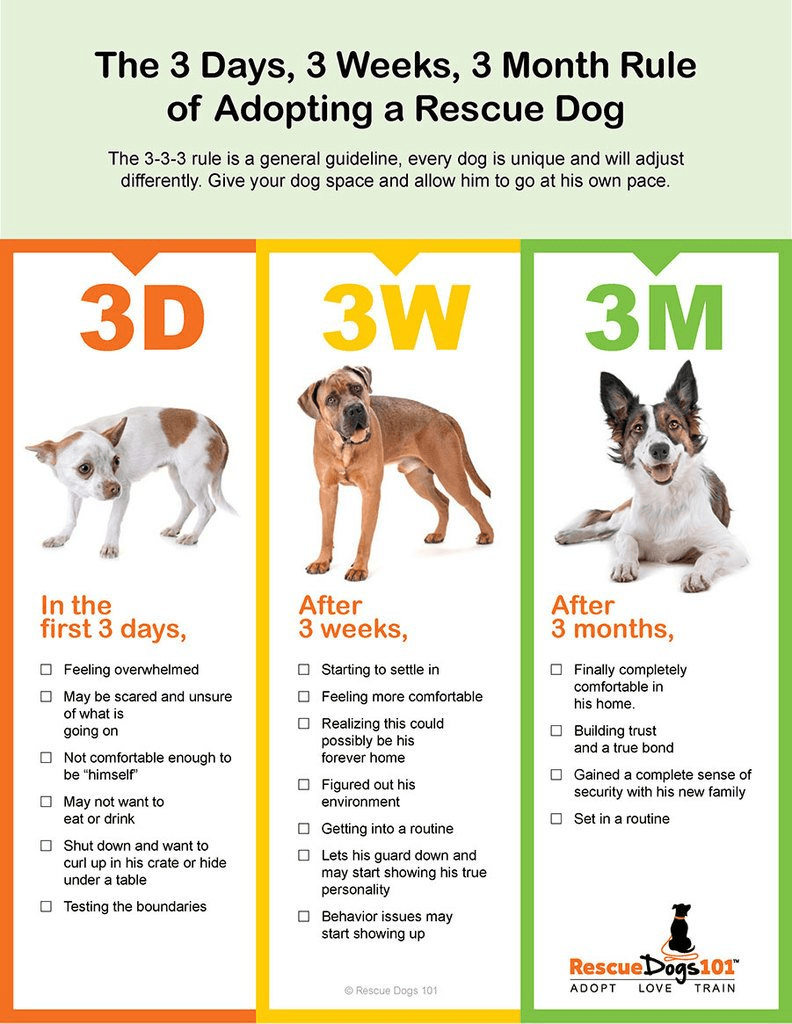
Infographic depicting the 3-3-3 rescue rule
Credit: RescueDogs101

It’s a general rule and not something that applies consistently across all rescues since every dog is different! When I first heard of this “rule,” it made perfect sense, though it didn’t seem to apply quite exactly with Cookie or Ziggy. They adjusted more quickly.

Meanwhile, this has fit Chip very well, but he’s probably taken a little longer with each phase. So far, Chip is our most challenging dog and can cause more frustration. BUT, it is SO rewarding to see how far he has come. Part of it is natural growing up, another part is continuing to adapt to a safe, loving, and stable environment, and yet another part is us figuring out and meeting his needs (i.e. sufficient enrichment and exercise).

This approximate timeline is important to consider when deciding to rescue. Be prepared to invest the appropriate amount of time before your new pack is running smoothly. Each dog will be different based on their history (which the degree of known detail will vary based on the circumstances they were found/surrendered) and their individual personality.

Bottom line: Be patient. Work with your pup and seek out professional trainers to help your pup adjust.

Barking is trainable
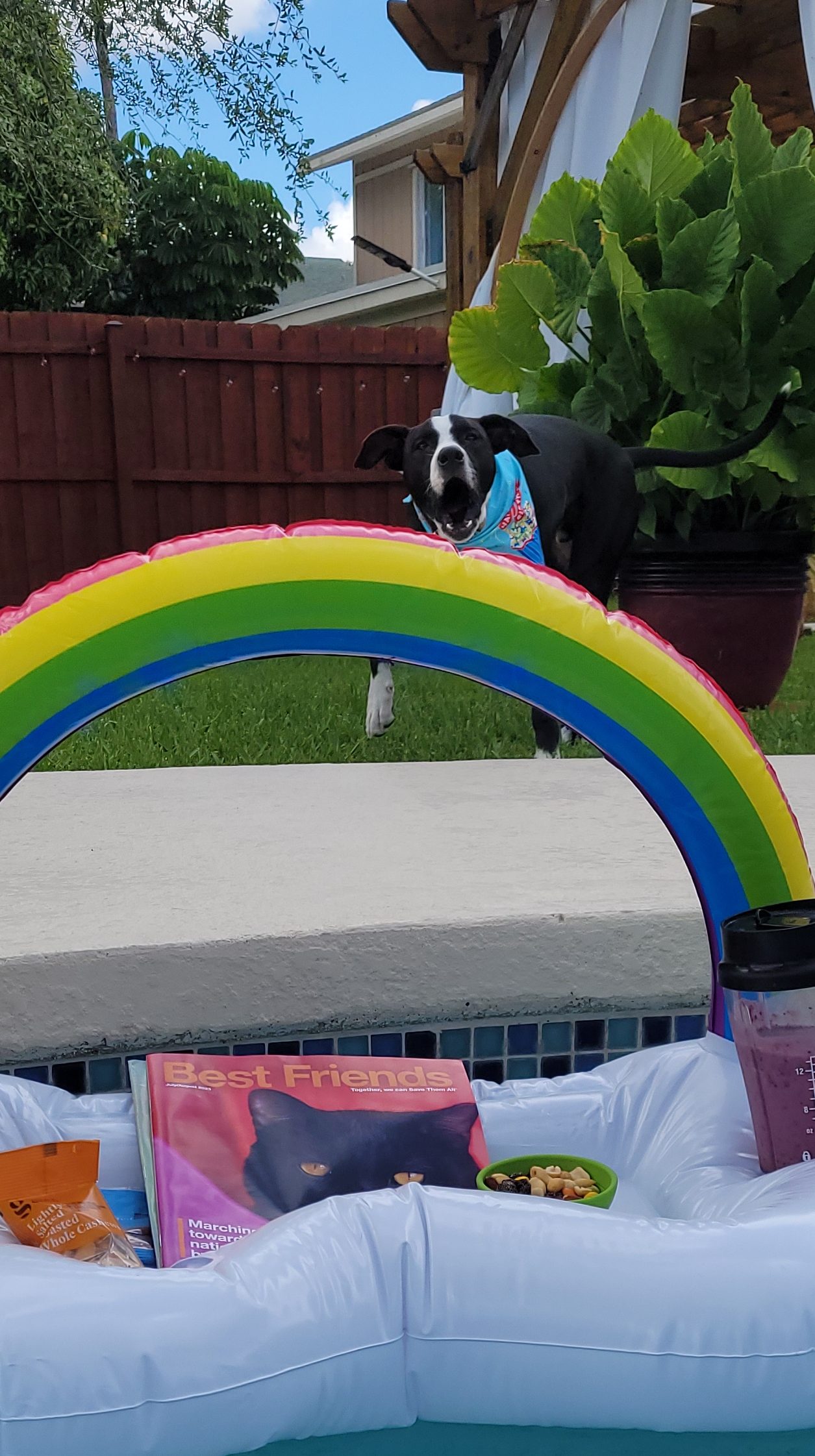
Chip barking at a pool float.

Cookie and Ziggy are not avid barkers. Sure, they’d bark if a delivery was being made or “suspicious” people walked past our house. But that was mostly it. Any other time they needed to communicate they would use their eyes or body language.

Not Chip. He is a “chatty Cathy.” While I believe that’s partially due to him having husky in him, it’s also been reinforced one way or another. Barking is a form of communication, and while we may not agree with the importance of why they’re barking, dogs are trying to communicate something when they bark.

For example, when I would shower and get ready for work, I would crate Chip in our bedroom just outside the master bath. At first, he would bark non-stop. Fortunately, I was able to be in his line of sight if I left the door open. So, when he was quiet, I would reward it – with LOTS of verbal praise and treats, when I could.

He quickly learned that I was nearby and that he didn’t need to narrate the entire time I was in the shower.

Other scenarios are harder to train (though professional trainers are more likely to offer up better tools than me), but with time they’re doable. In the beginning, for many reasons, we would walk Cookie and Chip separately. We couldn’t always ensure that one of us was home with Chip while Cookie would get walked. So he was crated, and for Cookie’s 20-minute walks, Chip would bark almost non-stop.

Over time, he grew more confident that he wasn’t being abandoned and that we always came back. We also slowly started testing the waters leaving him uncrated during her walks. Thankfully, those experiments were successful, and the combination of time and being uncrated worked for Chip.

Bottom line: The key with barking is to make sure you reward the silence, not the barking – particularly in scenarios where the barking isn’t appropriate. Barking is a natural dog behavior and shouldn’t be eliminated, simply managed. Find professional trainers that can help you modify the behavior.

Reactivity isn’t a bad word

Before Chip, “reactivity” had a bad connotation for me. I took it to mean an aggressive, unapproachable, unsocial dog. But it’s not.

Reactivity is simply a dog responding to stimuli in the environment. It could be for a multitude of reasons including overexcitement and fear.

One account that does a great job educating and bringing awareness on reactivity.

I’m still learning how to best support Chip and set him up for success. Sometimes his reactivity is clearly fear, and other times excitement. Those are his main drivers, but there are other times when it’s hard to tell.

We’ve taken a training class specific for reactive dogs, and I continue to learn by following experts such as Dynamite Dog Training (one of several of Chip’s teachers), r+dogs, and Dog Training Academy Florida.

Bottom line: Be open to the “reactive” dog label. Whether your dog is reactive or not, I encourage learning more about reactive dogs because it can help you support pawrents of reactive dogs when you encounter them.

Life lesson: Stay tuned

Chip showing off "peek a boo" in his Canine Good Citizen class.
Chip showing off “peek a boo” in his Canine Good Citizen class.

One year in is too early to pick Chip’s life lesson, so you’ll have to stay tuned as he grows up to see what else he teaches us!

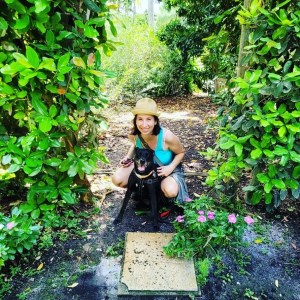
Hi, it’s nice to meet you!

Welcome to my site! I’m Jessica, and I’m a Dog Mom. I started the pawrenting journey in 2014 when my husband and I adopted Cookie. Since then, we’ve also adopted Ziggy and Chip. I’ve learned a lot over the years, and I look forward to sharing my experiences with you.

About me

Cookie and me at dog day at a local botanical garden
Photo Credit: My mom

I’ve always loved dogs since I was a kid. I convinced my parents that I should get a dog because I was the only one who had never had a dog, and fish didn’t make good pets because you couldn’t take them for a walk. (I was 8, and I was terrible at walking Lady.)

After my childhood dog passed away while in college, I decided I didn’t want to get another dog until I was on my own. Like in many households, I may have been the one that advocated for getting and ultimately picked Lady, but she quickly became my mom’s dog.

I have worked in the corporate world in marketing and product management. In the years since adopting Cookie, I’ve gone down the rabbit hole of “crazy” Dog Mom. I would love to be a stay-at-home Dog Mom or otherwise immerse myself in the world of dogs. Maybe that’s in the cards, or maybe my love of dogs will be what keeps me sane in the professional world.

Why Blog, Why Now

In March 2019, my husband and I adopted our second dog, Ziggy. He was three months old when we brought him home. About six months into the pandemic, in October 2020, Ziggy was diagnosed with cancer. Two months shy of his second birthday, his hind leg was amputated, and right around his second birthday, we finally learned what kind of cancer he had – hemangiosarcoma.

Hemangiosarcoma is a cancer of blood vessels. It is common and often has a very short survival time (about six months). Ziggy lived with hemangiosarcoma for 17 months. He died just three months after his third birthday.

As our journey into canine cancer began, I learned SO much – not just about canine cancer, but canine health in general. There is so much that seems obvious when you learn it, but it is counter to common knowledge or what we knew as kids with our dogs.

Dogs are incredibly precious to me. They are loving, and loyal and bring us so much joy. No matter how long they live, their lives are always too short.

With each of our dogs, I learn something that makes me a better Dog Mom to the next dog in our life. I want to do everything I can to give them the longest, best life possible. And I want to help like-minded pawrents do the same for their pups.

Meet The Pups

Now it’s time to meet our dogs, and the family dogs, that will make appearances in future posts.

Cookie

Cookie flying over an agility jump at the 2019 Tailwaggers CPE agility trial.
Photo Credit: Robin T. Brumfield

Cookie made me a Dog Mom. My husband and I adopted her in September 2014 when she was three months old. She benefitted greatly from being an only child for years.

She is incredibly smart, a fast learner, a good two shoes, strong willed, friendly but anti-social, and an amazing athlete. Cookie introduced us to the world of dog sports beyond obedience.

While Cookie earned titles in agility, barn hunt, and tricks, she also tried tracking and nose work.

Ziggy

We brought Ziggy home in March 2019, also aged three months. He was our first second dog. Ziggy was my greatest teacher and the inspiration for this blog.

There will be many posts about everything that Ziggy taught me, but the top two are how to advocate for your dog and how to pawrent two dogs.

Ziggy was the happiest, friendliest, and sweetest pup. His tail was always thumping, and he was delighted to go with the flow. I hate that he had to be one for half of his too short life, but he was also a fantastic patient.

Cookie introduced us to dog sports, and Ziggy introduced us to canine holistic health care.

Chip

Chip laying in the grass trying to take off his bandanna on his first birthday.
Photo Credit: Me

Seven months after Ziggy passed, we made room in our hearts for our second second dog, Chip. In October 2022, Chip became the third dog to enter our home at the age of three months.

Chip is a firecracker, and our biggest challenge. He is vocal, anxious, stubborn, silly, sweet, and smarter than I often give him credit for. Chip lived through a lot in his first three months of life, and it shows. It hasn’t quite been a year, but he has come SUCH a long way.

In under a year Chip has taught me that patience and love pays off. He reinforced a lesson learned with Ziggy – that every dog is different. Most importantly Chip is teaching me how misunderstood reactive dogs are.

The family dogs

Lastly are two girls no longer with us, Lady and Brie.

Lady joined our family in 1991 and passed in 2004. Compared to the dogs I have now, she was tiny – just 20 pounds! But boy did she have presence. While she was only ever taught the most basic obedience commands, Lady was very well behaved and super smart. She was healthy her whole life, until the last year or two when she was on several heart medications.

Brie replaced me when I moved out on my own. My mom lasted five months after I moved out before bringing home Brie. She was at least a year old when she joined the family in 2007 and she crossed the rainbow bridge in 2019. Brie never played, was a steady companion, apparently could hold a grudge, had separation anxiety, and taught Cookie how to behave and paw at the door. (Meanwhile, Cookie taught Brie how to bark and eat grass.)

Here we Go

In a nutshell that’s me and the dogs of my life. I look forward to sharing lessons learned, resources I turn to, products I’ve tried, and countless silly stories.

An important note and reminder: I’m not a veterinarian, certified dog trainer, or other dog professional. I’m a dog mom sharing her tales in pawrenting.

While I hope that my experiences help you, I’m only an expert in the dogs that I’ve lived with (and even with them, I’m always learning). So please, consult the experts that are part of your pack for the needs the pups in your life. When applicable, I’ll link to accounts of the professionals that I follow.